project-image

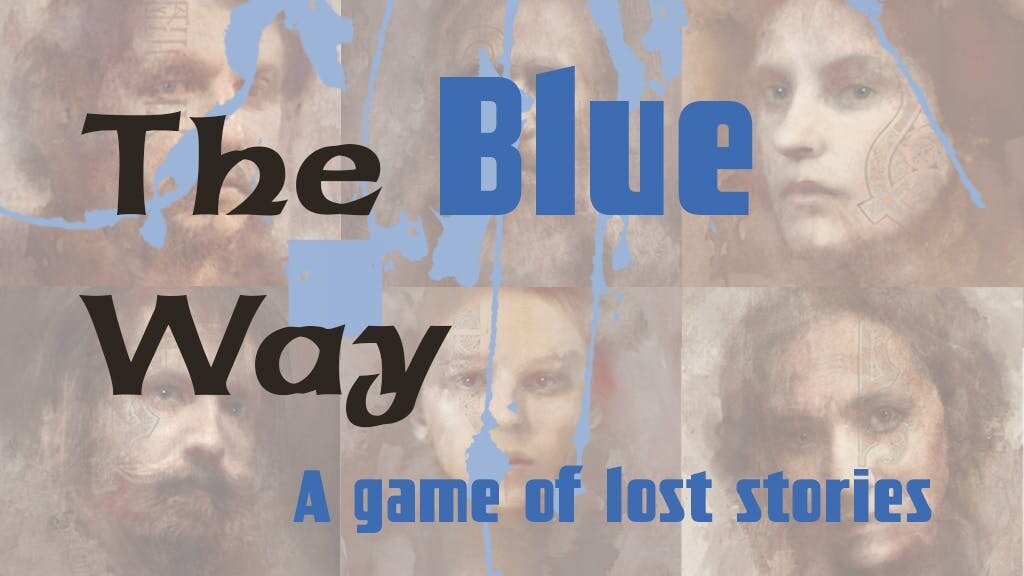
The Blue Way: A Game of Lost Stories

Created by Central Michigan University Press

The Blue Way is a game of lost stories, colonialism, and its cultural aftermath from Jason Morningstar and Central Michigan University Press. **Orders in the Preorder Store will not charge credit cards until Backerkit campaign surveys close in November 2026. Preorder backers will receive updates and email communications about this before it happens.

Latest Updates from Our Project:

Halfway There!
about 2 months ago – Tue, Jun 16, 2026 at 02:02:16 PM

You have carried us across the halfway mark! Thank you so much for your support and enthusiasm for The Blue Way! 

We are excited to see how fast we can smash our goal -- keep it going!


LAUNCH!
about 2 months ago – Tue, Jun 16, 2026 at 08:49:55 AM


Hello, all!

We are THRILLED at the response to The Blue Way so far! (Please remember to also check out our friends at Jaunty Goblin Games and back their game, Chancers, so you can get the awesome whorl dice and the creepy but gorgeous card sleeves with art by Samuel Araya!)

We wanted to take a minute to highlight something else really cool in this campaign -- a surprise add-on! After you choose your pledge level for The Blue Way, continue to the Add-Ons section, and you will find the option to buy a shirt with art from The Blue Way, Dog Eat Dog, or The Mountain Witch! (Or, you know, they might all have to join your closet...)

Thanks again for your support! We're so excited to see where we are at the end of our first day of crowdfunding -- keep it up!!

Happy Launch-Day Eve!
about 2 months ago – Mon, Jun 15, 2026 at 05:37:42 PM

Hello, all!

We are so excited for tomorrow's launch of The Blue Way! If you haven't already, follow our prelaunch page to make your pledge when the official page goes live!

We are also excited that our friends at Jaunty Goblin Games will be launching Chancers tomorrow, too! As a reminder, people who back both The Blue Way and Chancers will receive a set of Samuel Araya's illustrated card sleeves and three awesome whorl dice!

Thank you to everyone who has supported this project so far -- we can't wait until tomorrow!

Ray Kimball The Blue Way Curriculum Guide Q&A
2 months ago – Thu, Jun 11, 2026 at 07:44:50 AM

Hello, friends of CMich Press and The Blue Way!

Today we want to introduce you to Dr. Ray Kimball, one of the authors behind The Blue Way Curriculum Guide, and share a bit of his experience. (If you have played Eyeball to Eyeball: The Cuban Missile Crisis from CMich Press, you already know his work!) Read on for more!

Q: What is your background/connection to education and games? 
RK: I started using games as a junior faculty member at West Point in 2005 because I was teaching in the core first-year history curriculum, which meant half of my students at any given time weren't taking the class voluntarily. I needed something to keep them engaged, and classroom tabletop and role playing games quickly became the way I did that. 20 years on, I've been creating classroom games and helping others do the same. I currently run an educational games coaching service helping higher ed and corporate educators bring games into their learning spaces. [42 Educational Games Coaching and Design]
 
Q: What did your process look like for creating the Curriculum Guide?  
RK: It was really important to me to understand Jason's vision for the game and how he wanted people to experience it. Reading some older interviews about the first edition and a Beyond Solitaire podcast about the CMU revision was incredibly helpful to me in creating material that was respectful to the game itself. Then I put myself in the shoes of a teacher playing the game: What could potentially go wrong? Where were my students most likely to struggle in the game? What were the portions most likely to generate "aha" moments? At the same time, I tried to think about all of the different types of classes that might use this game, both in terms of subject matter and size, composition, etc. The result (I hope) is a document that makes the game accessible without compromising the core ideas of the game.

Q: What element was the most challenging to develop? 
RK: Although The Blue Way doesn't directly reference any particular historical era, it draws heavily from several that are outside of my general area of expertise. I felt compelled to explore some of the recent scholarship on the lived experience of colonialism to make sure the things I was creating were both academically rigorous and useful from a classroom context. Jon Truitt was incredibly helpful in this respect, steering me to some work on the colonization of Mesoamerica that I would never have found on my own.

Q: What from The Blue Way and its Curriculum Guide would you be most excited to use in your own teaching space?  
RK: I'm always excited to get a new game from CMU Press into my hands! For this game especially, I'm excited about the new artwork. It creates such an amazing sense of dread and dehumanization that perfectly captures the game's themes. 
 
Q: Do you have any advice for educators who are considering using games in their classrooms but haven’t made the leap yet? 
RK: Find something that's familiar to you and start there. You probably have more games in your life than you might think, and some component of one of them is just waiting to be put to use in your class. And if that’s too much of a struggle, just hire me. :D
 
Q: Do you have anything else you’d like to share?  
RK: If The Blue Way is your first introduction to CMU Press games, welcome! I hope you’ll explore their library of other games to see the amazing stuff they have on offer - including my game, Eyeball to Eyeball: The Cuban Missile Crisis. If you’re a returning CMU Press customer, thanks for joining me in supporting this incredible outlet and their work. Either way, I hope you’ll jump on the Backerkit when it opens in June!

***

Thanks, Ray! We are so excited for the upcoming launch for The Blue Way -- only a few days now! Follow the prelaunch page to get an alert when we go live on June 16th!
 

Jason Morningstar Design Q&A
2 months ago – Tue, Jun 09, 2026 at 07:13:13 AM

Hello, all!

Today we're rolling out a design Q&A with Jason Morningstar that will take you behind the creation of The Blue Way. Jason is the designer behind big hits like Fiasco, Desperation, and, recently, Zhenya's Wonder Tales. (Is June 16th here yet?!) Without any further ado, please enjoy his thoughts on The Blue Way:

Q: What motivated you to create this game? Where did the first idea come from?  
JM: The Blue Way was the result of a deep dive into the fall of the Ēxcān Tlahtōlōyān to the Tlaxcalans and their Spanish allies, starting in 1519. I was particularly struck by the conquest’s aftermath, where indigenous art, religion, politics, and culture were simultaneously overtly destroyed and also assimilated into Spanish colonial rule. In some cases historians have little to go on in understanding pre-contact Aztec life and in others they must rely on pretty suspect primary sources literally written by the victors and their proxies. What remains is sometimes a patchwork that tells a story, but not, perhaps, the whole story. You have to read between the lines. This dynamic plays out again and again all over our world (The Roman arrival in Britain in 43 AD is another great example of this process), and we’ve lost so much. It got me thinking, and as a game designer that’s usually trouble. 

There are lots of games about colonialism, most of them sort of horrifying at a slight remove (I’m looking at you, Puerto Rico). I think you can argue that even games like Dungeons and Dragons are colonial enterprises at heart. Most of them are written from the point of view of the colonizer - traditionally, someone making a roleplaying game about the the fall of the Ēxcān Tlahtōlōyān would position the player’s characters as heroic Spanish adventurers. I wondered how to invert that tired formula.

Q: What surprised you during the development of this game? Did you learn/try anything new?  
JM: Something I learned in playtesting The Blue Way was that players often approached the game from wildly different points of view that made for a great shared experience. When one player really digs in and resists the Dusians, and another cares so deeply for all the things they hold dear that they are willing to make painful sacrifices to accommodate the newcomer’s demands, a spectrum of responses emerges that is both useful and entertaining for everyone to observe. There’s no wrong way to approach play, but the game really sings when you get diverse opinions and decisions.

Q: Did the story or the mechanics come first? How did you pair them together?  
JM: In designing the game, I knew I’d need a destructive mechanism to simulate the loss of cultural assets, and that drove the design process. The “story” bits - both the actual stories and the many difficult, card-based inputs that would challenge the players to make awful choices, came later. The societies of the Dusians and the Sathani sort of grew organically as I wrote the prompts, but the framework was in place. 

Q: How did you develop the world of The Blue Way? What were some of your influences?  
JM: Throughout the design process, the Spanish colonial rule of the Valley of Mexico in the 1520s and beyond, was on my mind. My other two touchstones were the Roman conquest of Britain and the much-later Norman conquest. I think you could easily make a list of dozens of similar events worldwide. I wanted big, obvious differences, so the invading culture is sort of medieval in its outlook and a little hierarchical and effete perhaps. It doesn’t really have a clue about, or respect for, Sathani culture, which is pastoral, agrarian, and tied to the land in specific, religious, ways. There’s no cultural value judgment implied, but all the Dusian colonizers you meet are terrible people, just the worst. 

Q: What was something you chose not to include in this game?  
JM: One of my initial decisions was about abstraction - did I want to make a game about a historical moment, like the Norman conquest, or did I want to abstract it into a low fantasy analog? The advantages of the former are obvious - historical grounding, the ability for the participants to become WIkipedia-level authorities if they want, maybe lessons made more impactful by being pulled from real life. The advantages of the latter were persuasive, though - abstraction made the themes universal and - more importantly - removed the participants from any responsibility for “getting it right”. I make a lot of games where I make the opposite decision, and in those, I need to be very careful about supporting the players and helping them avoid what I call “history panic” - excessively worrying about making mistakes when playing out real events. It’s counterproductive and no fun at all. If The Blue Way was going to be about the cultural impacts of colonialism and assimilation, I wanted to foreground that - not historical minutia. I would abstract it, make up my own low fantasy analogs, and make it approachable. 

Q: What do you want players to take away from your game? What do you want them to learn/feel/reflect upon?  
JM: I feel like games like The Blue Way are a really good way to provoke a little empathy and help people wonder about the topic. I don’t pretend to be an expert or authority, and my ultimate goals are to create a fun experience (by some definition of fun) and infect the participants with a little curiosity about the subject matter. In the case of The Blue Way, I’d love it if they’d emerge from the game reconsidering how the topics of colonialism and assimilation are generally addressed (or ignored) in games. 

Q: How do you see this project as unique compared to your others? How does it borrow/connect to your other games?  
JM: The Blue Way is a logical extension of my design work both procedurally and thematically. Procedurally I love card-based play, which has so many great advantages in a contained-but-replayable experience. You see that all over my design work, from the second edition of Fiasco to my latest game, Zhenya’s Wonder Tales. In terms of theme, it aligns with other games of mine that are history-inflected or even history-dominated. The Blue Way is abstracted the way games like The Lesser Players’ Tale or The Broadcast are, and for all the same reasons (approachability, universality, avoiding “history panic”).  

Q: Is there anything else you’d like players to know about this game or how it was created?  
JM: I’m really proud of The Blue Way and I hope that people will engage with it thoughtfully but enthusiastically. It’s a pretty heavy game, so be kind to yourself and your friends when you play. In my experience it is very rewarding and fun. 

***

Thanks, Jason!

We can't wait for the launch of The Blue Way's crowdfunding campaign in ONE WEEK! Follow the prelaunch page now to be one of the first to back this standout project and explore its secrets for yourself.